
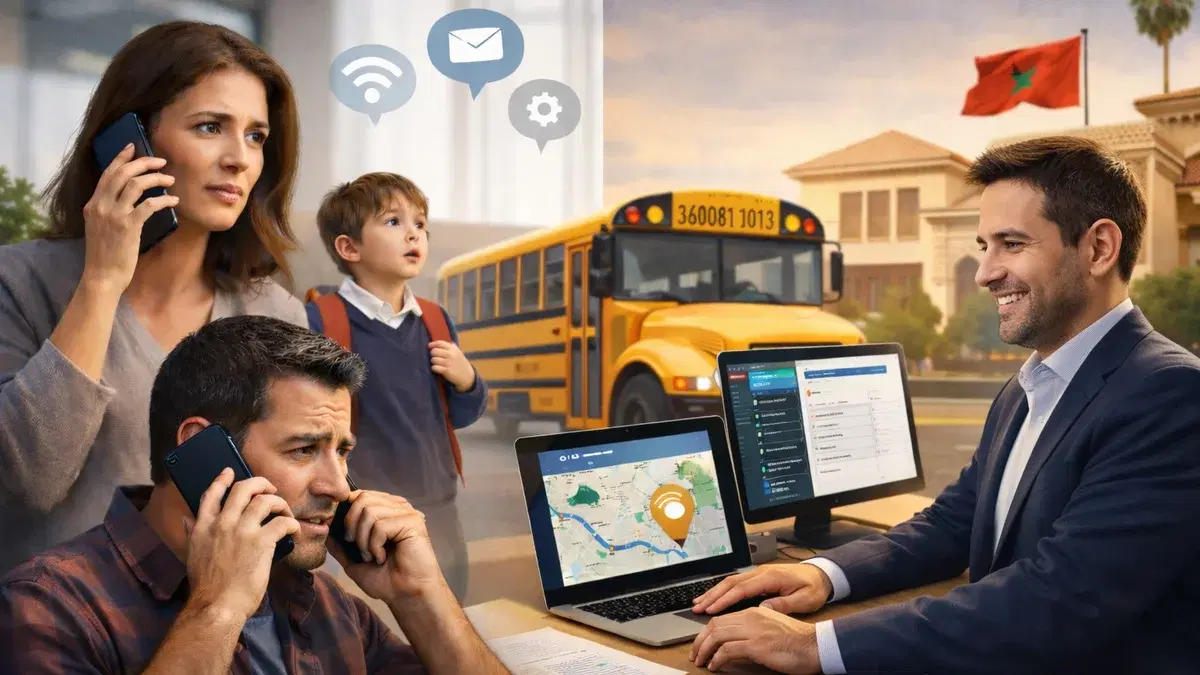
Monday, 8 a.m. The school day hasn't even started and the front-desk secretary has already logged six calls: three parents want to know where the bus is, one reports that a bus never showed up, two want an explanation for Friday's delay.
In under an hour, the team has already burned a meaningful slice of its morning on school bus enquiries — time stolen from its real job: running the academic and operational engine of the school.
This scene repeats every day in most private schools across Morocco. It exposes a structural problem: when information only circulates on demand, it arrives too late — and it arrives as a phone call.
Why parents call about the school bus
Parents who call rarely do it to complain. They call because they're trying to make sense of a situation they can't see: a journey that happens out of their sight, in a context they don't control.
The moment a usual drop-off time slips without any word, an information gap opens. It's not the delay itself that triggers the call — it's the absence of reliable, timely information. In that vacuum, picking up the phone becomes a reflex.
The anxiety isn't proportional to the real severity either. A two-minute delay can generate as many calls as a serious one. The constant variable is the same: whether clear information lands at the right moment.
Schools that understand this mechanic stop managing anxiety after the fact. They organise information upstream.
The four types of parent calls
In conversations with directors across Morocco, daily parent calls fall into four recognisable families.
1. The anxious call
"The bus is late — where is my child?" The most frequent and most emotionally charged call, driven directly by uncertainty.
2. The logistics call
"My child won't be on the bus tomorrow." Simple requests — but a steady stream of them, because there's no structured channel for the parent to use.
3. The dispute call
"The driver shouted at my daughter." Or "A secondary student pushed her."
Sensitive situations where the parent expects a clear answer and visible action, and where — without verifiable facts — every exchange hinges on competing versions of the same event.
4. The distrust call
"Has the bus passed its technical inspection?" Or "Who was driving this morning?"
Less frequent but more telling: these calls signal that a parent is questioning the transparency of the system itself. They're not asking about a specific incident — they're checking whether the school actually has things under control.
Schools that structure their school bus operations don't eliminate these calls by accident. They reduce the volume sharply by making information accessible, clear and verifiable. In most cases, the information that would have triggered the call is already in the parent's hand before the urge to pick up the phone arrives.
What Moroccan parents actually expect
A parent of a child in a Moroccan private school is asking for three simple things:
- To know that their child boarded the right bus at the expected time.
- To be able to locate the bus easily, especially when it's running late.
- To be able to report an absence or a concern, without having to call the school.
None of this is exotic. None of it requires complex tools. It requires a reliable, structured, systematic system — exactly what phone calls and WhatsApp groups can't provide.
A three-layer parent communication framework
Schools that master their transport communication organise it around three complementary layers.
1. Proactive, automated information
On every boarding and alighting, the parent receives a timestamped notification. When a significant delay happens, an alert goes out before uncertainty has time to settle in.
Every key event — boarding, drop-off, delay — produces immediate, reliable, systematic information.
The parent no longer has to ask. They're informed automatically.
This first layer alone dismantles most anxious calls, because it removes their root cause: no information at the moment it's needed.
2. An official, individual, auditable channel
Logistics requests stop going through the secretary. They go through a dedicated channel: an app or parent portal where families declare an absence, request a one-off stop change, or log any specific need.
Each action is recorded, timestamped and reviewable, by the school and by the parent.
The daily operation shifts shape: call volume drops, information gains clarity, and every request becomes auditable — which creates a shared, documented trail of what was asked, approved and delivered.
3. Structured incident handling
For dispute and distrust calls, what actually cuts volume isn't the tool — it's the availability of evidence.
Every event — route, stop, attendance, intervention — is recorded, timestamped and reviewable, giving the school immediate access to reliable and verifiable information.
This transforms sensitive situations: the volume falls, exchanges become clearer, and every conversation leans on factual elements. The school stops just replying — it grounds its answer in facts, which restores a calmer relationship and a shared accountability around incidents.
Why WhatsApp isn't enough (even though it's here to stay)
WhatsApp is everywhere in Moroccan schools, and trying to remove it is unrealistic. But as the primary channel for school bus operations, it hits three structural limits:
- It dilutes accountability. In a group of dozens of parents, a message is addressed to no one specifically, and it can't be clearly assigned or tracked.
- It amplifies tension. A complaint that isn't handled fast becomes visible to everyone, turning a one-on-one issue into a public thread.
- It isn't auditable. Finding out, weeks later, who reported what and when — and what the reply was — is difficult and sometimes impossible.
For the school bus, WhatsApp belongs in the informal layer. Anything with an operational consequence — absence, stop change, incident — has to flow through an official, structured, auditable channel, so clarity, accountability and traceability hold up over time.
What schools that structure their communication actually measure
Schools that structure their parent communication observe concrete, measurable shifts within a few months:
- A sharp drop in school bus-related call volume, typically in the 70 to 90 percent range.
- Far shorter handling time on sensitive situations, from several hours down to a few minutes, thanks to immediate access to the facts.
- Fewer start-of-year tensions, the time of year traditionally marked by transport-related misunderstandings.
- A direct impact on how the school is perceived: the quality of school bus service becomes a deciding factor for families.
These outcomes don't come from a single tool. They come from a structured communication framework, made workable every day by a system that handles information reliably, auditably and systematically.
FAQ
How do you actually reduce parent calls about the school bus?
The main lever is moving from reactive communication — where parents call to get information — to proactive communication, where the school pushes the information before the question is even asked.
In practice, that rests on three complementary building blocks: systematic notifications at every boarding and drop-off, an automatic alert when a significant delay happens, and an official channel where parents can track the bus and log an absence without ever picking up the phone.
Schools that put this framework in place typically see a sharp reduction in school bus-related calls, reaching 70 to 90 percent within a few months.
Does a real-time tracking app replace phone calls entirely?
It doesn't eliminate them — it sharply reduces them.
A real-time tracking app absorbs most of the anxious calls — "where is the bus?" — and a large share of logistics requests, like flagging an absence or a one-off change. By keeping information continuously accessible, it stops these situations from ever turning into calls.
What remains are the more sensitive situations that require a human exchange: driver behaviour, an incident between students, or an exceptional decision.
For those cases, the app doesn't replace the conversation — it structures it. It provides timestamped, verifiable data — stop history, student attendance, driver identity — so the school can answer with facts instead of assumptions.
How do you handle parent complaints about a driver's behaviour?
Handling a complaint well starts with a clear, auditable framework.
The first step is formalising the complaint in an official channel, so its content and timestamp are captured precisely. A complaint received over the phone or through an informal channel (usually WhatsApp) is hard to work with and hard to follow up later.
The school can then lean on objective elements — GPS history, actual schedule data, student attendance, and video footage where available — to reconstruct what happened within a short time frame.
The answer given to the parent is then built on verifiable information: what actually happened, what was checked, and — where relevant — the measures put in place.
This approach turns an emotional moment into a structured, fact-based process, while protecting the child, the driver and the school at the same time.